The program ran dozens of lecture groups (52 at the time, tested up to 300) across Telegram, WhatsApp, and Drive links, tracked manually. When a customer asked something as simple as "where’s my group’s WhatsApp link" or "when does the recorded lecture go up," the operations team often couldn’t answer fast — and that delay was directly causing refunds. Lecturers, meanwhile, kept having to ask which groups were assigned to them and which needed follow-up.
The scope was deliberately kept small: this wasn’t going to be a large system, so a serverless architecture was the right fit rather than over-engineering infrastructure for a dataset the size of ~50–300 groups. The build was scoped to solve the actual bottleneck — getting every piece of scattered information (links, assignments, upload status) into one connected view — rather than becoming a general-purpose LMS.
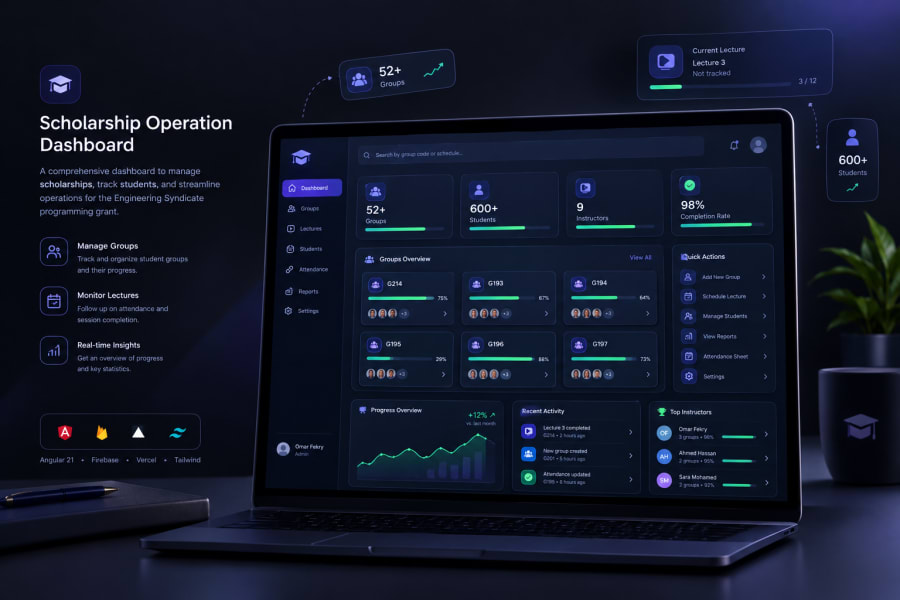
Built solo in about a week using Angular, TypeScript, and Tailwind on the frontend with Firebase/Firestore as a lightweight serverless backend. Lecturers get their own dashboard showing which groups they’re teaching, what’s been covered, what’s pending, and which groups are missing follow-up on Telegram/WhatsApp. The moment a lecturer marks a recording as uploaded, that status is visible to the operations team immediately — replacing what used to live in scattered paper notes and spreadsheets. Adding a new group or lecturer takes one action ("Add New Group") instead of a manual, ad-hoc process.
The hardest part wasn’t the code — it was compressing a genuinely messy, multi-channel operational problem into a single screen that a non-technical operations team could use immediately, with zero training.
AI disclosure
AI tools were used as a thinking partner for brainstorming architecture and to accelerate implementation once the approach was clear. The problem understanding, architectural decisions, and final implementation were Muhammed’s — his existing Angular/Firebase experience is what let him verify and adjust the codebase directly.
Questions that used to take minutes to resolve (which group, what link, what time) now resolve in seconds. Refund-driving support delays tied to lost information were eliminated. The system was stress-tested to 300 groups against an actual load of 52, so it has headroom to scale with the program.